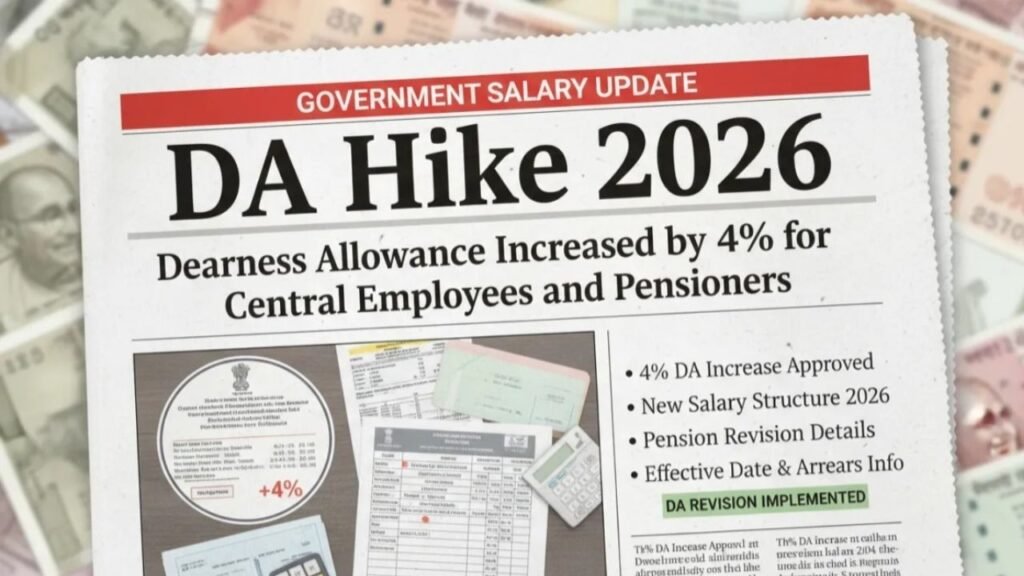
DA Hike 2026: In a move that will be felt around millions of kitchen tables, the Central Government has announced a 4% increase in Dearness Allowance (DA) for its employees and Dearness Relief (DR) for pensioners, effective for 2026. This decision injects a much-needed financial boost into households that have been quietly grappling with the rising cost of everything from vegetables and fuel to school fees and medical bills. For families whose income is largely fixed by government pay scales, this adjustment is a practical tool for managing the month-to-month reality of inflation. This revision is more than just a percentage point change in an official circular. It’s a direct response to the persistent pressure on household budgets felt over the past couple of years. While private sector incomes might see bonuses or market-linked variations, government compensation is designed with a built-in shock absorber: the DA mechanism. This latest hike, calculated based on prescribed formulas, serves as an economic buffer, helping to ensure that a government job or pension continues to provide a reliable foundation for a family’s financial life.
A 4% Hike What It Actually Looks Like in Your Pocket
While a 4% increase might sound modest in headline terms, its real impact is best understood in rupees and paise. Since DA is calculated as a percentage of one’s basic pay, the actual amount varies, but the gain is tangible for everyone. For a junior employee with a basic salary, the extra money each month could mean not having to choose between buying quality vegetables and saving for a child’s school trip. For a senior officer, it might cover the yearly increase in health insurance premiums or contribute to a recurring deposit. Pensioners, who receive this as Dearness Relief, will see a similar uplift. This is particularly significant for senior citizens who often face rising healthcare expenses without the possibility of supplementing their income. A few hundred extra rupees each month can mean the difference between stretching a medicine or buying it on time, between worrying about a utility bill or paying it with confidence. The table below illustrates how this increase translates for employees and pensioners at different pay levels.
| Employee/Pensioner Category | Approx. Basic Pay / Pension | Current DA/DR (Assume 56%) | New DA/DR (60%) | Monthly Increase | Annual Increase |
|---|---|---|---|---|---|
| Entry-Level Employee | ₹25,000 | ₹14,000 | ₹15,000 | ₹1,000 | ₹12,000 |
| Mid-Level Employee | ₹55,000 | ₹30,800 | ₹33,000 | ₹2,200 | ₹26,400 |
| Senior Employee | ₹1,10,000 | ₹61,600 | ₹66,000 | ₹4,400 | ₹52,800 |
| Pensioner (Retired at Mid-Level) | ₹27,500 (50% of basic) | ₹15,400 | ₹16,500 | ₹1,100 | ₹13,200 |
| Pensioner (Retired at Senior Level) | ₹55,000 (50% of basic) | ₹30,800 | ₹33,000 | ₹2,200 | ₹26,400 |
(Note: These figures are illustrative. The previous DA rate of 56% is used as a baseline for this calculation. Actual amounts depend on individual basic pay as per official records.)

How the DA Hike is Calculated A Look Under the Hood
The decision to increase DA isn’t arbitrary; it’s driven by a clear, data-backed mechanism. The government tracks the movement of the All-India Consumer Price Index for Industrial Workers (AICPI-IW), which measures the change in prices of essential goods and services. When this index shows a sustained rise in inflation, accumulated points trigger a revision in DA. The 2026 increase is a direct reflection of the price pressures that have built up in the economy, particularly in essential categories like food, housing, and healthcare. This formula acts as a vital stabilizer for public sector incomes. It’s an automatic response designed to protect the purchasing power of salaries and pensions from being silently eroded by inflation. It means that a government employee’s real wage—what their money can actually buy—remains relatively stable, even when the economy faces turbulent times. This predictability is a cornerstone of financial security for millions of families.
The Ripple Effects Arrears, Taxes, and Smart Financial Moves
The immediate benefit of the DA hike will be visible in salary slips and pension credits. Often, these revisions are implemented with a slight retrospective effect, meaning employees and pensioners may receive a lump sum payment as arrears for the months between the effective date and the implementation date. This lump sum can act as a welcome financial cushion, perhaps used to pay off a small debt, cover a child’s annual school fees, or make a much-needed household purchase. In many towns and cities, these collective payouts can even give a noticeable boost to local markets. However, it’s also important to understand that a higher DA increases your total taxable income. Without careful planning, a portion of the gain could go toward higher taxes. This makes the DA hike a good time to review your investments. Consider maximizing deductions under sections like 80C (through PPF, ELSS, or life insurance premiums) or 80D (for health insurance). The goal is to ensure that this real increase in your income translates into long-term wealth, rather than just a temporary bump that gets eaten up by taxes or day-to-day expenses.
The Bigger Picture The 7th Pay Commission and What Lies Ahead
The current DA structure operates within the framework of the 7th Pay Commission, which was implemented in 2016. Over the years, as inflation has fluctuated, these regular DA revisions have made the allowance a very significant part of total compensation. This naturally leads to discussions about the future. Employee unions and policy watchers are increasingly looking ahead to the possibility of a new Pay Commission. Historically, when DA accumulates to a very high percentage, a new pay commission is often constituted to undertake a comprehensive review. One of its key tasks is to merge the accumulated DA into the basic pay, effectively resetting the salary structure. So, while today’s 4% hike provides immediate relief, it also adds to the momentum for larger structural discussions about the 8th Pay Commission. For now, the focus remains on the tangible benefit landing in bank accounts—a small but significant step in keeping pace with the cost of living.

FAQs
1. What is the new Dearness Allowance (DA) rate for central government employees?
The government has approved an additional installment of 4% DA, effective for 2026. This will take the total DA from its previous rate to a new rate of 60% of the basic pay.
2. From which date is this DA hike applicable?
The hike is effective from a specified date in 2026. Employees and pensioners will receive the increased amount in their salaries/pensions accordingly, and any arrears from the effective date to the implementation date will be paid separately.
3. How much more money will I get in hand?
The increase depends on your basic pay. For every ₹100 of basic pay, you will now receive ₹60 as DA instead of the previous rate. For example, if your basic pay is ₹50,000, your monthly DA will increase by ₹2,000 (4% of ₹50,000).

4. Will pensioners also get this increase?
Yes, the same 4% increase applies to Dearness Relief (DR) for all central government pensioners. Their monthly pension will increase by 4% of their basic pension.
5. Is the increased DA taxable?
Yes, the entire Dearness Allowance is a part of your salary and is fully taxable as per your applicable income tax slab. It is advisable to review your tax-saving investments to optimize your in-hand salary.
6. What is Dearness Relief (DR)?
Dearness Relief is the exact equivalent of Dearness Allowance, but it is paid to pensioners. It ensures that their pension amount keeps pace with inflation, just as DA does for serving employees.