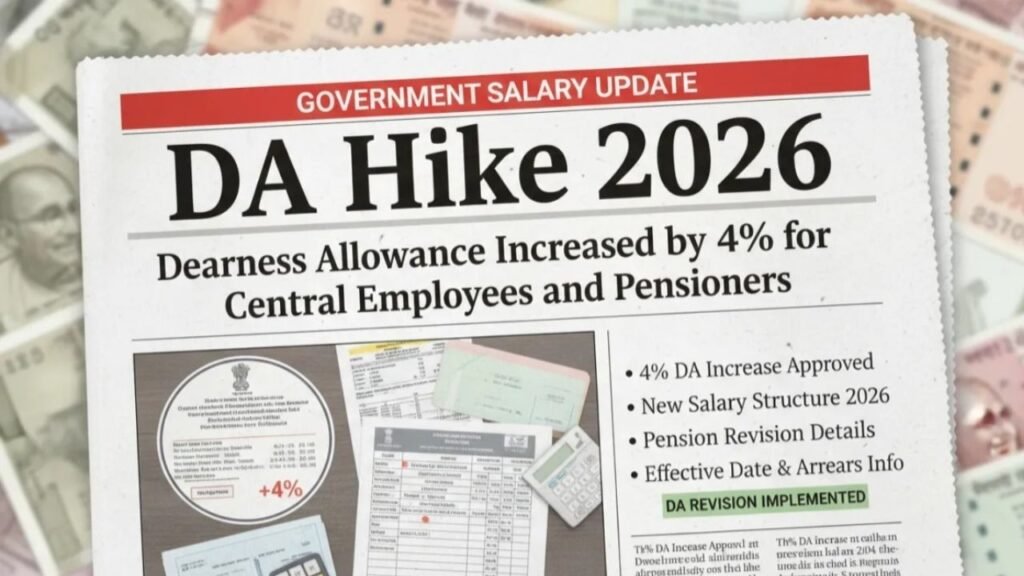
DA Hike 2026: The announcement of a 4% rise in Dearness Allowance (DA) for central government employees and Dearness Relief (DR) for pensioners in 2026 brings practical relief at a time when everyday expenses continue to rise. This revision, approved by the Government of India, is aimed at helping salaried employees and retired individuals maintain their purchasing power as prices of essential goods and services increase. For many households that depend on fixed incomes, DA acts as an important adjustment tool rather than a bonus. It helps ensure that salaries and pensions do not lose value due to inflation, offering financial stability and predictability in uncertain economic conditions.
How the Increase Reflects in Monthly Income
A 4% increase in DA may appear small at first glance, but its real impact becomes clear when translated into monthly income. Since DA is calculated as a percentage of basic pay or basic pension, the benefit rises proportionally with salary level. For working employees, the additional amount can support routine household needs, education expenses, or savings. For pensioners, the increase is especially meaningful, as it helps manage recurring costs such as medical care and utilities. nstead of being a one-time benefit, the hike adds a permanent increase to monthly income, improving long-term financial comfort.
The Basis of DA Calculation
The revision of DA is not discretionary. It follows a structured formula linked to changes in consumer price data, which tracks inflation across essential goods and services. When inflation crosses certain thresholds, DA is revised accordingly. This system ensures transparency and consistency in compensation adjustments. The current DA framework operates under the recommendations of the 7th Pay Commission, which established the present salary and allowance structure for central government staff.
DA Hike 2026 Overview
| Category | Details |
|---|---|
| DA / DR Increase | 4% |
| Applicable To | Central government employees & pensioners |
| Effective Year | 2026 |
| Previous DA Rate | 56% (assumed baseline) |
| New DA Rate | 60% |
| Calculation Basis | Inflation-linked consumer price index |
| Governing Framework | 7th Pay Commission |
| Tax Status | Fully taxable |
| Mode of Payment | Monthly salary/pension (with arrears, if applicable) |
Arrears, Tax Impact, and Financial Planning
In many cases, DA revisions are implemented with effect from a prior date. When this happens, employees and pensioners receive arrears for the intervening period as a lump-sum payment. This amount is often used for clearing pending expenses, meeting annual commitments, or strengthening savings. However, DA forms part of taxable income. As income increases, tax liability may also rise. This makes it a good time to review tax-saving options such as long-term savings schemes or health insurance coverage, ensuring that the increased income results in lasting financial benefit.
Looking Ahead in the Pay Structure
As DA continues to rise over time, it becomes a larger portion of total compensation. Historically, when DA reaches high levels, discussions around revising pay structures gain momentum. While no official announcement has been made, the steady increase keeps attention focused on future pay review mechanisms. For now, the 2026 hike offers immediate and tangible support to millions of households.
FAQs
Q1. What is the new DA rate after the 2026 hike?
After the 4% increase, the DA rate rises to 60% of basic pay or basic pension.

Q2. Who benefits from this DA increase?
All eligible central government employees and pensioners receive the increase as DA or DR.
Q3. Will arrears be paid with this hike?
If the implementation date is later than the effective date, arrears for the pending months are generally paid.
Q4. Is Dearness Allowance taxable?
Yes, DA is fully taxable and included in total income for tax calculation.

Q5. How is Dearness Relief different from DA?
Dearness Relief is paid to pensioners, while Dearness Allowance is paid to serving employees. Both serve the same purpose.
Q6. Does this hike affect future pay revisions?
While it does not directly change pay structure, rising DA levels often influence discussions on future pay commission reviews.
Final Note
The DA Hike 2026 is a measured response to inflation, designed to protect income stability rather than create short-term gain. For employees and pensioners alike, the increase strengthens monthly financial planning and reinforces the role of DA as a vital economic safeguard.